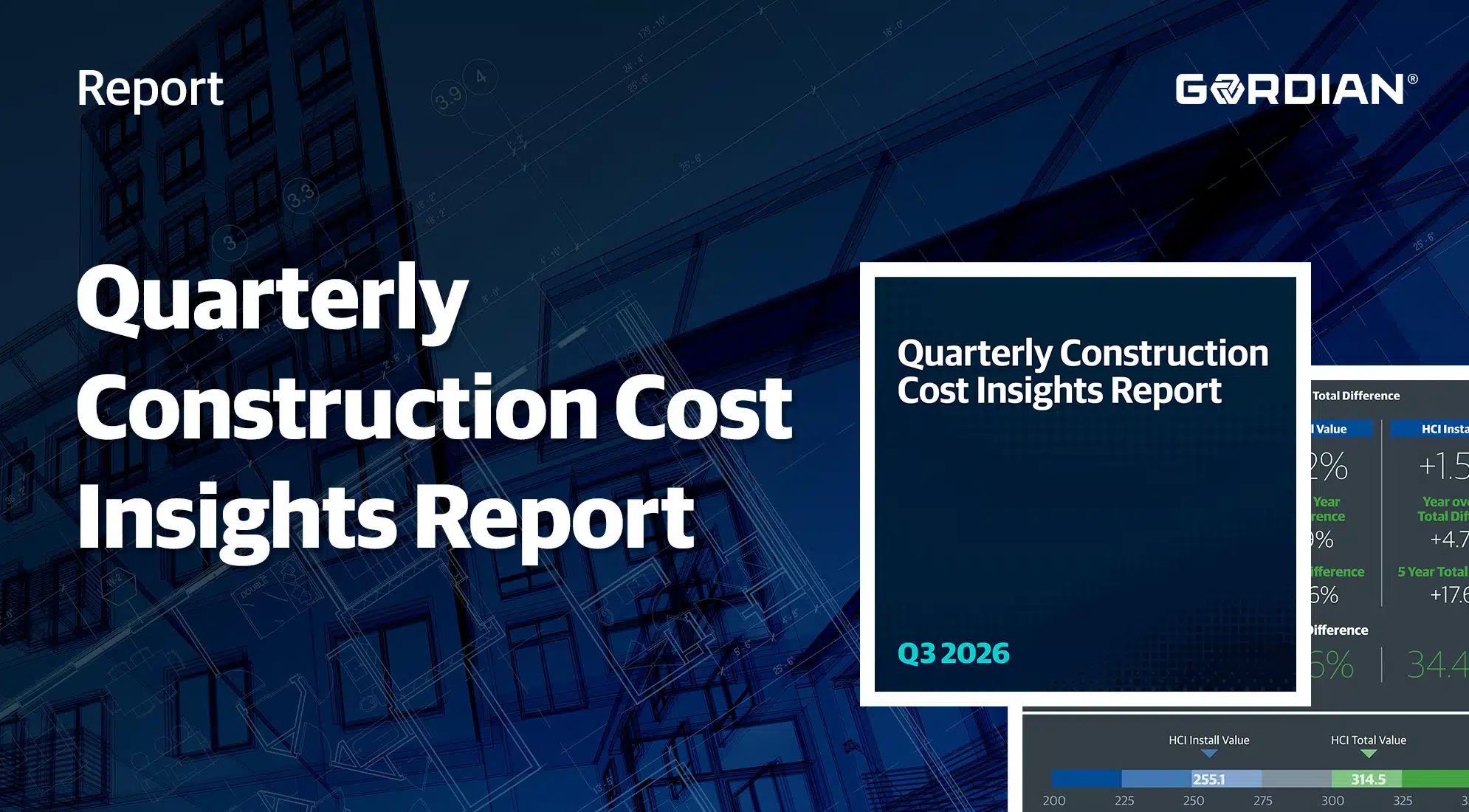


Every quarter, Gordian lends its data and insights to the Construction Cost Insights Report. Produced in partnership with Building Design+Construction, the report features market analysis from industry leaders based on their experiences, observations and Gordian’s RSMeans™ Data construction cost database. The industry standard for cost accuracy, RSMeans Data contains over 92,000 unit line items comprised of material, labor and equipment prices localized to 970+ locations. Available digitally and in print, this data is backed by more than 30,000 hours of research every year.
We recently published the latest Construction Cost Insights Report, covering Q4 of 2025. The newest edition highlights several trends that industry leaders are keeping an eye on as we head into 2026. Below, we highlight three of them.
Divergent Material Cost Trajectories
Now that we’re well into Q4, it is safe to say that 2025 has been a volatile year for metals. Copper wire costs, for example, began the year with a modest uptick only to tumble in the second quarter, then come roaring back, surging by 12% in Q3, and finishing 2025 with a tiny dip of 0.37%. Talk about whiplash. Steel prices followed a similar up-and-down path in the back half of 2025, reaching a high in Q3 and a low in Q4. Thankfully, these wide wild cost swings were specific to the metals market.
Framing lumber costs had been steadily increasing for three quarters before a modest 3.52% Q4 decrease spurred by improving mill output and seasonal demand. Contrast that dip to Q4 of 2024, when lumber prices dropped nearly 5.5%, and you’ll see that lumber costs were relatively stable for the year. Concrete block offered 2024’s steadiest costs, a trend that continued in Q4, as prices rose a mere 2.5%. Over the year, concrete block unit costs have ranged between $2.39 and $2.46, a model of consistency.
Taken as a whole, the volatility of the metals market and the stability of the other core materials have created a cost balance with little overall growth or decline. Our Historical Cost Index for material value, which tracks the overall change in raw material costs, is up only 2.61% year over year.
Download the Q4 Construction Cost Insights Report for deeper analysis of cost movement and robust discussion of industry trends.
Growing Labor Costs
Our Q4 Construction Cost Insights Report contains a disquieting estimate from the Associated Builders and Contractors (ABC), a national trade association with more than 23,000 members. The ABC estimates that the construction industry will need approximately 499,000 additional workers to meet demand in 2026. That gap, nearly half a million people, has major implications.
The labor shortage is already inflating wages, and travel premiums and other costs threaten to offset gains from steadying material prices. In fact, Gordian’s data shows that labor-related expenses now outpace materials in total cost escalation across several key trades.
Novel Approaches to Risk Mitigation
Given the volatility of the metals market and broader economic instability, contractors are taking measures to reduce their risk exposure. Escalation clauses are becoming commonplace and restructured to more evenly allocate risk between owners and contractors. These clauses are especially common on large-scale projects (think big, industrial facilities like data centers).
Further, contractors are working closely with material manufacturers and suppliers to reduce the risk of long lead times. Large construction firms are increasing and expanding vendor outreach to stay on top of cost movements to procure materials when it is most advantageous to do so. These adjustments reflect a broader recalibration of procurement behavior for both contractors and project owners. There is nothing to suggest that this recalibration will cease.
Gordian will continue analyzing construction cost changes and industry trends so you always know what the data says. To get an early look at what our experts anticipate for next year, register for our 2026 Construction Cost Trends Webinar.